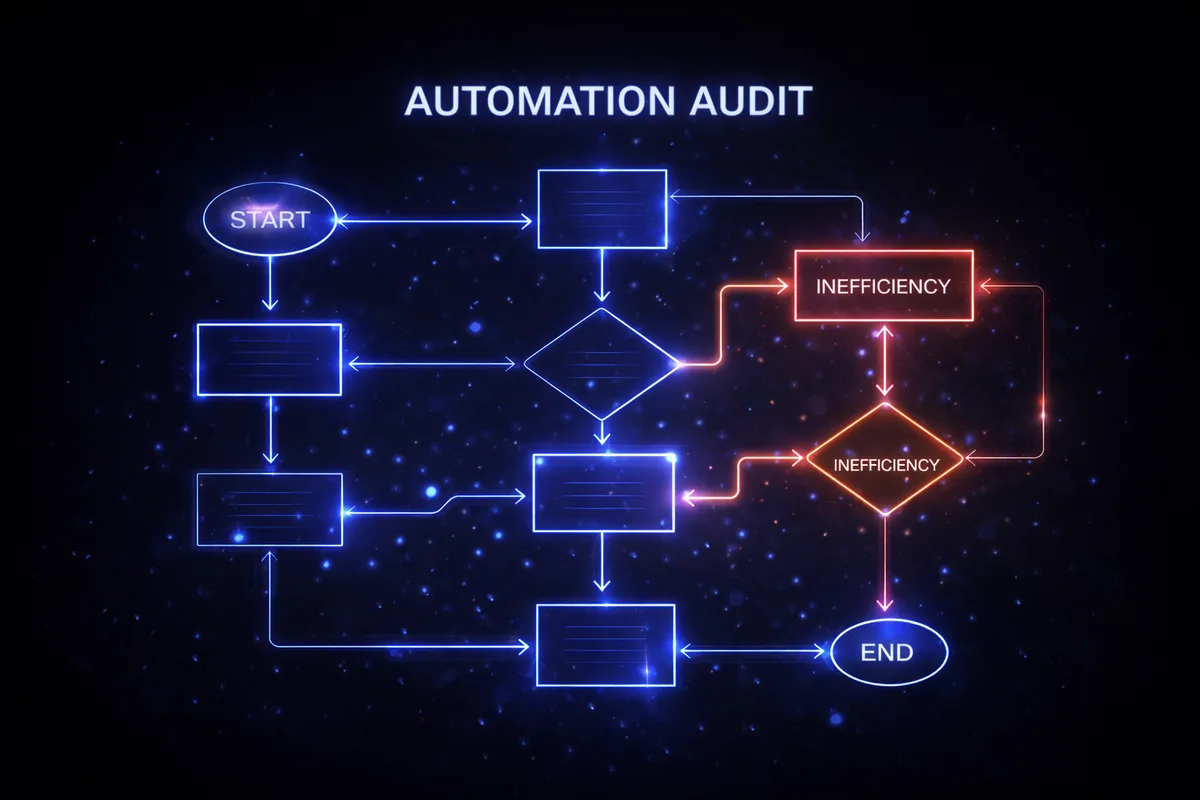
Most businesses have thousands of dollars in annual operational waste hiding in manual processes. Not because they're poorly run — but because when you're inside a process every day, you stop seeing the inefficiency. It becomes 'just how things work.'
We've developed a systematic framework for identifying these opportunities. Here's the exact process we use, so you can run it yourself.
Step 1: Map the Process Landscape
Before you can automate anything, you need to see everything. Start by listing every recurring process in the business. Not the big strategic initiatives — the daily and weekly tasks that keep operations running.
We use a simple spreadsheet with four columns: process name, who does it, how often, and estimated time per occurrence. Have every team lead fill this out for their department. Don't worry about automation potential yet — just document what exists.
In a typical small business, this exercise surfaces 20-50 distinct recurring processes. Most leadership teams are surprised by the volume — they're aware of maybe half of them.
Step 2: Score Each Process
For each process, score three dimensions on a 1-5 scale:
Volume (1-5): How frequently is this process executed? Daily = 5, Weekly = 4, Monthly = 3, Quarterly = 2, Annually = 1.
Time (1-5): How long does each execution take? More than 4 hours = 5, 1-4 hours = 4, 30-60 minutes = 3, 10-30 minutes = 2, Under 10 minutes = 1.
Complexity (1-5, inverted): How rule-based is the process? Fully rule-based = 5 (easiest to automate), Mostly rule-based with some judgment = 4, Mix of rules and judgment = 3, Mostly judgment-based = 2, Fully creative/strategic = 1.
Multiply the three scores. Processes scoring 60+ are your prime automation candidates. In a typical audit, 8-15 processes hit this threshold.
Step 3: Calculate the ROI
For each high-scoring process, calculate the annual cost:
Annual cost = Frequency x Time per execution x Hourly labor cost x 52 weeks
For example: a process done 5 times per week, taking 45 minutes each time, by someone earning $35/hour: 5 x 0.75 x $35 x 52 = $6,825 per year. That's just one process.
Now add error cost. If manual execution has a 5% error rate and each error costs $50 to fix: 5 x 52 x 0.05 x $50 = $650. Total annual cost: $7,475.
Sum these across your high-scoring processes and you'll typically find tens of thousands of dollars in annual operational cost that could be reduced significantly with automation.
Step 4: Prioritize by Impact-to-Effort Ratio
Not all automation is created equal. Some processes are expensive but hard to automate. Others are cheap to automate but only save a few hours per month.
We categorize opportunities into four quadrants: Quick Wins (high impact, low effort — do these first), Strategic Investments (high impact, high effort — plan these for phase 2), Easy Adds (low impact, low effort — batch these together), and Backlog (low impact, high effort — revisit later).
The Quick Wins quadrant is where you start. These are the processes that deliver fast, visible ROI and build organizational momentum for the bigger investments.
Step 5: Document the Current State
Before automating anything, document the process as it exists today. Not how it's supposed to work — how it actually works. Shadow the person who does it. Watch them click through screens, copy between tabs, and make decisions.
You'll discover two things: (1) the process has unofficial variations and workarounds that aren't in any documentation, and (2) some steps that seem necessary are actually vestigial — remnants of an older version of the process that nobody thought to remove.
This documentation becomes your automation spec. Every decision point, every data source, every output format, every edge case the human handles — these are the requirements your automation needs to address.
Common Findings
Across every audit we've run, these are the most common sources of hidden waste:
Data transfer between systems (30% of waste) — manually copying information from one system to another because they don't integrate. This is the single most common and most automatable process in every business.
Report generation and distribution (20% of waste) — pulling data from multiple sources, formatting it, and sending it to stakeholders. Often takes 2-4 hours per report, done weekly.
Approval routing (15% of waste) — chasing approvals through email chains, Slack messages, and follow-ups. An automated workflow with reminders typically cuts approval time by 60%.
Status checking and monitoring (15% of waste) — manually checking dashboards, inboxes, and systems for updates. Automated alerts eliminate this entirely.
Customer communication (10% of waste) — sending repetitive emails, updating CRM records, following up on inquiries. Templates and automation handle 80% of this volume.
Running Your Own Audit
You can run this audit internally with a half-day workshop. Gather your team leads, walk through the five steps above, and you'll leave with a prioritized list of automation opportunities with rough ROI estimates.
The output isn't a commitment to automate everything — it's visibility into where your operational dollars are going and which processes offer the best return on automation investment.
If you want a more detailed assessment, we offer free automation audits where we go deeper into process documentation, technology evaluation, and implementation planning. No strings attached — just clarity on what's possible. For context on which automation approach fits each process type, read our guide on RPA vs AI automation.